We are working to increase the formal recognition of preprints by funders and research institutions
The problem
A significant barrier to wider preprint adoption is the lack of formal recognition of preprints as valid outputs by funders, institutions and the wider research community.
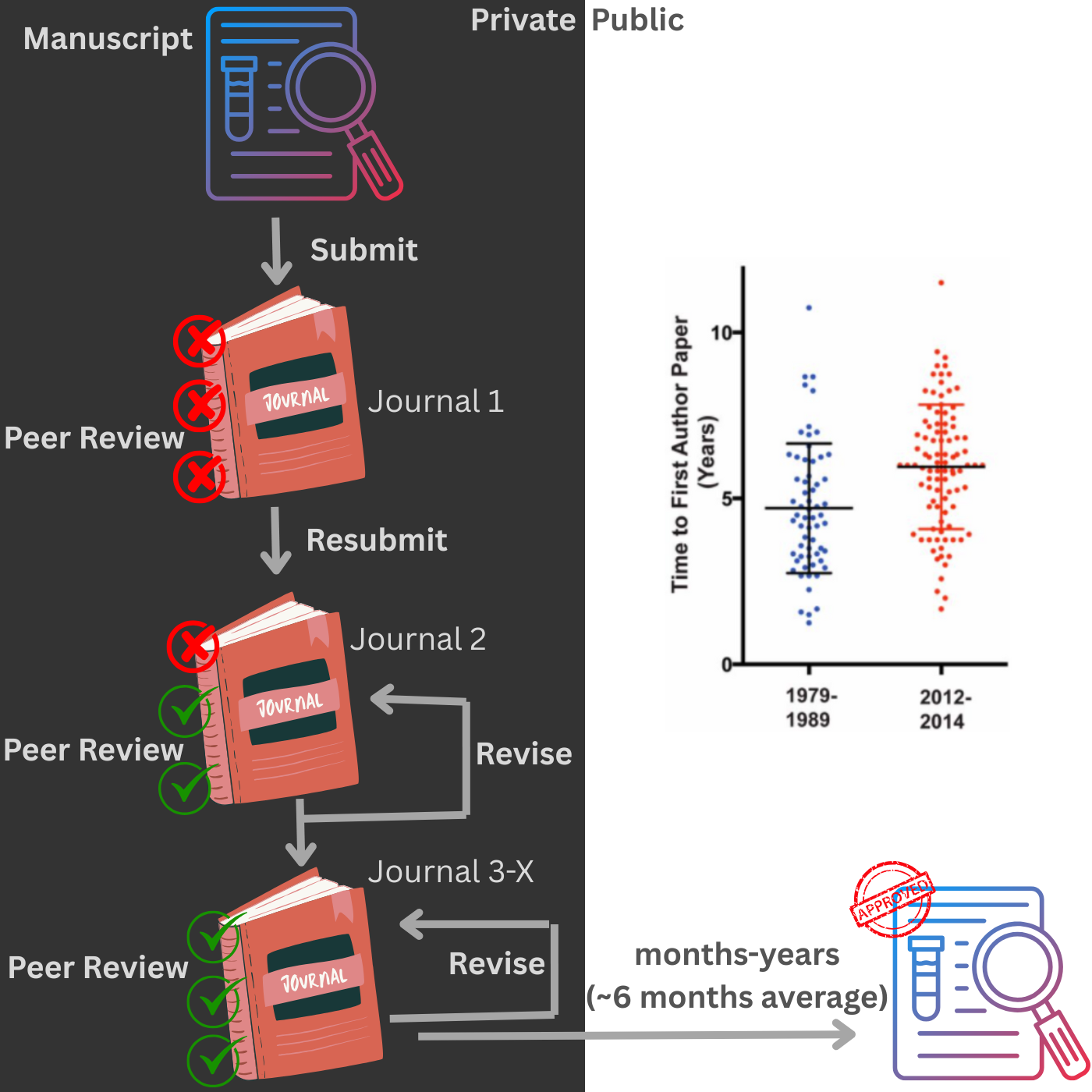
Thanks to efforts from organisations such as DORA and CoARA, this is slowly changing with some funders and institutions recognising preprints. However, these efforts do not go far enough and remain limited to a small number of actors that largely only recognise peer-reviewed preprints.This delays graduation, career advancement and limits the system from meaningfully changing.
The solution
To maximise the benefits of preprints, we must have formal recognition of stand-alone preprints. This enables us to move away from peer review as a sole indicator of quality in addition to reducing mental stress on PhD students or ECRs applying for positions.
Evidence consistently demonstrates that preprints are comparable to their published versions. Combined with the increasingly long review times and strained system, there is an increasing demand to move away from requiring publications to graduate or for fellowship applications.

Our current efforts

Changing PhD graduation requirements from papers to preprints
Increasing recognition of non-reviewed preprints

Formal policies for preprints in hiring & promotion
Preprint policies
Funder preprint policies
Institutional preprint policies
Resources
Frequently Asked Questions
Are preprints recognised by institutions and funders?
Recognition varies greatly between institutions and geographical region. Many universities and research organisations are increasingly acknowledging preprints as valid research outputs, especially for early evidence of productivity. In some cases, preprints may be included in CVs, grant applications, and during hiring or promotion processes. Several major funders now recognise preprints including the NIH, Wellcome Trust, and UKRI. Currently in most situations, only preprints associated with a peer review are formally recognised.
Can I include preprints on my CV, in grant applications or tenure dossier?
Yes, many institutions now allow or encourage listing preprints as evidence of productivity. For example, the NIH and several universities recognise preprints in grant submissions, CVs, and biosketches.
Do all fields and institutions formally recognise preprints?
Acceptance is expanding but is not universal. Some disciplines (e.g., physics, mathematics, life sciences) are more familiar with preprints. Humanities and some social sciences have been slower to adopt preprints. Institutional and field policies can differ significantly.
Can preprints be used in national research assessments such as the REF?
In the UK, for example, preprints are eligible for submission to the Research Excellence Framework (REF), provided they meet certain criteria and are properly deposited. Always check the latest guidance.
Where can I find my institutions preprint policies?
Check your institution’s library, research office, or official guidance on scholarly communications. We’re also hoping to survey institutional policies to provide a summary.
Why is recognition of preprints important?
Without formal recognition of preprints and other outputs, adoption will always remain limited as there would be no incentive beyond altruism. Formal recognition of preprints is a significant step in moving away from poor proxies, such as where a study is published or impact factors.

Join Us!
Join our community, sign up to our newsletter or collaborate with us
 Rippling Ideas